Frankenstein by Mary Shelley: Summary, Story & Audiobook
Apr 20, 2026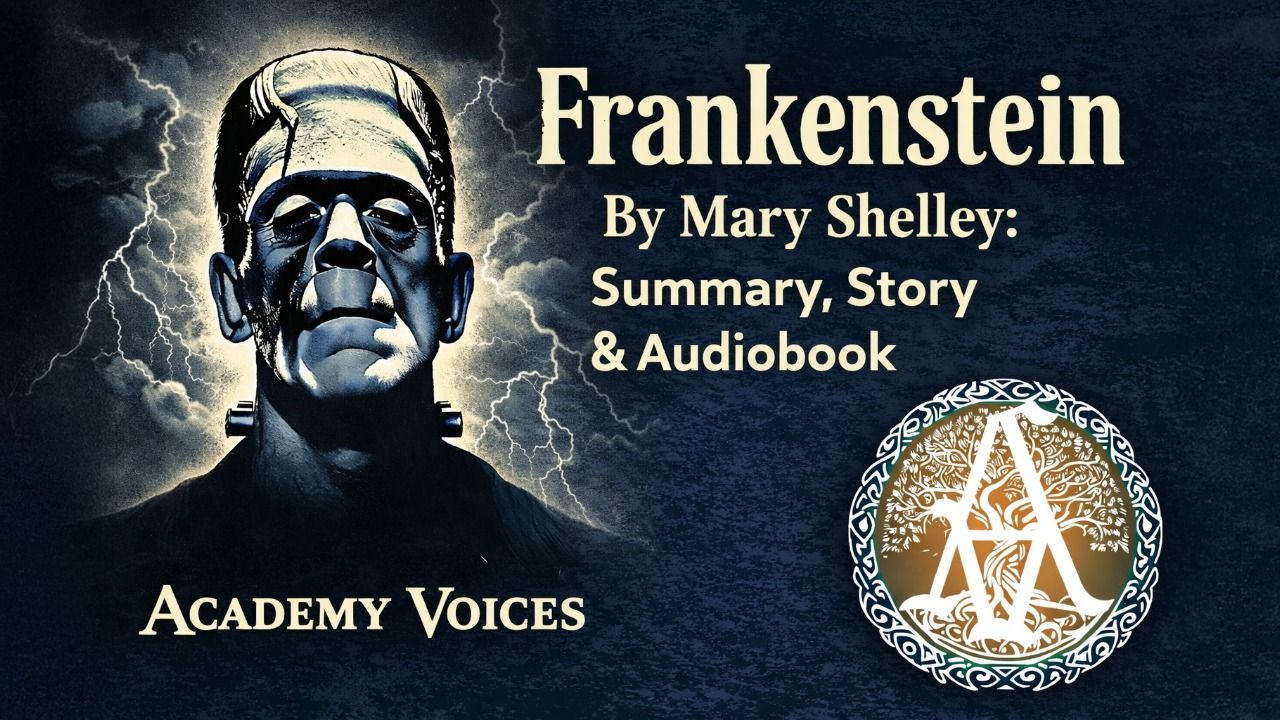
Listen to Chapter 1 Here:
Explore more: Get Frankenstein by Mary Shelley the audiobook here
Mary Shelley was eighteen years old when she dreamed up one of the most uncomfortable questions in all of literature: what does a creator owe the thing it brings into the world? She's been waiting for an answer ever since. More than two hundred years on, Frankenstein is still asking — and the question has never felt more urgent.
This is one of those rare books that gets bigger the closer you look. The story most people think they know — mad scientist, bolt-necked monster, 'It's alive!' — is almost entirely the invention of Hollywood. What Shelley actually wrote is stranger, sadder, and far more morally complicated than any of that.
The Story: What Frankenstein Is Really About
The novel opens not with Victor Frankenstein but with a different obsessive entirely — Robert Walton, an Arctic explorer writing letters to his sister from the deck of a ship locked in polar ice. When his crew pulls a dying man from the frozen sea, that man turns out to be Victor Frankenstein, and what follows is the confession he makes before the cold takes him.
Victor grew up in Geneva, the eldest son of a prosperous and loving family. As a young man he becomes consumed by one idea: he wants to discover the secret of life. Not in the abstract philosophical sense — he literally wants to create it. After years of secret study at the University of Ingolstadt, he succeeds. He assembles a body from the remains of the dead and jolts it into life.
Then he runs away. The creature is alive, enormous, and terrifyingly real — and Victor can't bear to look at it. He abandons it without a name, without care, without anything at all.
What happens next is where the novel becomes something special. The creature isn't a monster in the sense of being incapable of feeling. He's intelligent, sensitive, and profoundly alone. He teaches himself to read. He watches a family through a cottage window for months, learning everything about human connection — love, kindness, generosity — while being entirely excluded from it. When he eventually tries to make contact with the world, the results are catastrophic. He is met with violence and horror everywhere he turns.
"I was benevolent and good; misery made me a fiend. Make me happy and I shall again be virtuous." — The creature, Frankenstein
The creature's fury turns toward Victor — the one person responsible for him — and the two are locked into a pursuit that tears across Europe and eventually into the Arctic, each one destroying everything the other loves along the way. By the end, you're not sure who deserves your grief more: the scientist who played God without thinking it through, or the being he created and then refused to take responsibility for.
About Mary Shelley: The Teenager Who Changed Literature
Mary Wollstonecraft Shelley was born in London on August 30, 1797, the daughter of two extraordinary minds. Her father, William Godwin, was one of the most influential political philosophers of his era. Her mother, Mary Wollstonecraft, wrote A Vindication of the Rights of Woman — one of the founding texts of Western feminism. She died from complications of childbirth eleven days after her daughter was born.
Mary grew up immersed in ideas: about science, about rights, about what humanity owed itself. In 1814, aged sixteen, she eloped with the poet Percy Bysshe Shelley. Two years later, during a cold, stormy summer on the shores of Lake Geneva, the couple joined Lord Byron and his physician John Polidori at the Villa Diodati. Unable to go outside, the group challenged each other to write a ghost story. Mary had a waking nightmare — she saw a pale student kneeling over the creature he had made, watching in horror as it stirred to life. She couldn't shake it.
That nightmare became Frankenstein. She completed the novel in 1817. It was published anonymously on January 1, 1818 — many reviewers assumed the author was a man. A revised and expanded edition appeared in 1831 under her own name, and it's that version most readers encounter today. She went on to write several more novels, but Frankenstein remains the work that defines her legacy. She died in 1851 at fifty-three.
What makes the authorship remarkable isn't just her age — it's what she was carrying. The losses, the radical intellectual inheritance, the questions about creation and responsibility that came from her own life. Frankenstein isn't an abstract thought experiment. It's personal.
About the Narrator: James Scott
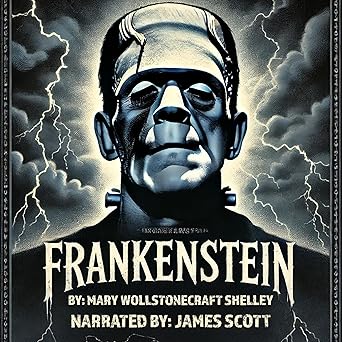
Our edition of Frankenstein is narrated by James Scott — a professional voice actor whose measured, controlled delivery is ideally suited to the weight of Shelley's prose. Gothic literature asks a lot of a narrator. The pacing has to build dread without tipping into melodrama, and the philosophical passages — of which there are many — need to land with genuine gravity, not just be read aloud.
Become a narrator for Academy Voices
What Scott does well is restraint. He lets the creature's most heartbreaking moments speak for themselves rather than performing them, which is exactly right for a novel where the horror is not supernatural but human. The nested structure of the book — letters containing a confession containing a confession — requires the listener to stay oriented across multiple voices and timeframes, and Scott holds that architecture together cleanly throughout.
This edition is published by Anthony Pica Productions, LLC, and is available unabridged on Audible, Amazon, and anywhere audiobooks are sold.
Why Frankenstein Works So Well as an Audiobook
Frankenstein is built around narration — nested, layered, one voice inside another inside another. Walton tells us what Victor told him. Victor tells us what the creature told him. This can feel slightly complex on the page, but when it's spoken aloud, it becomes natural. Each voice takes on its own register, and you understand intuitively that you're hearing a story that has passed through multiple people before it reached you. That emotional distance — the sense of something terrible being recounted long after it happened — is one of the novel's defining qualities, and it's never more apparent than in audio.
Shelley's prose is also extraordinarily atmospheric. Storm-lashed Alpine passes, the desolation of the Arctic, a half-lit workshop at one in the morning. Listened to with headphones in the dark, this book is something else entirely.
Listen to the Academy Voices Edition
If you've never read Frankenstein — or if you read it in school and let it fade — this is the version to come back to. Narrated by James Scott and produced by Academy Voices, it's available now on Audible.
We have hundreds more classic literature audiobooks in our collection — from Edgar Allan Poe and Bram Stoker to Jane Austen, Oscar Wilde, and beyond, all narrated by professional human voice actors. Browse our full classic collection and find your next listen.
Frequently Asked Questions
Is Frankenstein the monster or the scientist?
Frankenstein is the scientist — Dr. Victor Frankenstein. His creation is never given a name in the novel and is referred to simply as 'the creature' or 'the monster.' The confusion is deliberate in a way: Shelley never quite lets you settle on who the real monster is. That's the point.
When was Frankenstein first published?
The first edition was published anonymously on January 1, 1818. A revised and expanded edition appeared in 1831 under Mary Shelley's name — it's this later version that most modern readers encounter, including our Academy Voices audiobook edition.
What genre is Frankenstein?
Frankenstein is most often described as gothic horror, but it's also widely considered one of the first science fiction novels ever written. It blends Romantic poetry, philosophical inquiry, epistolary fiction, and horror into something that still doesn't fit neatly into any single category — which is a large part of why it has lasted.
Is Frankenstein good as an audiobook?
We'd argue it's better as an audiobook than on the page. The nested narrative structure — a story within a story within a story — feels completely natural when voiced, and Shelley's atmospheric, sensory prose is made for listening. It's one of the titles we recommend to anyone who thinks they don't like classic literature.
Is the Academy Voices edition unabridged?
Yes — our edition is unabridged, meaning you hear the complete text of the novel as Shelley wrote it, nothing cut or condensed.
Explore more: Get Frankenstein by Mary Shelley the audiobook here